
Help Homeowners Find, Trust, and Contact Your Business When They Need You
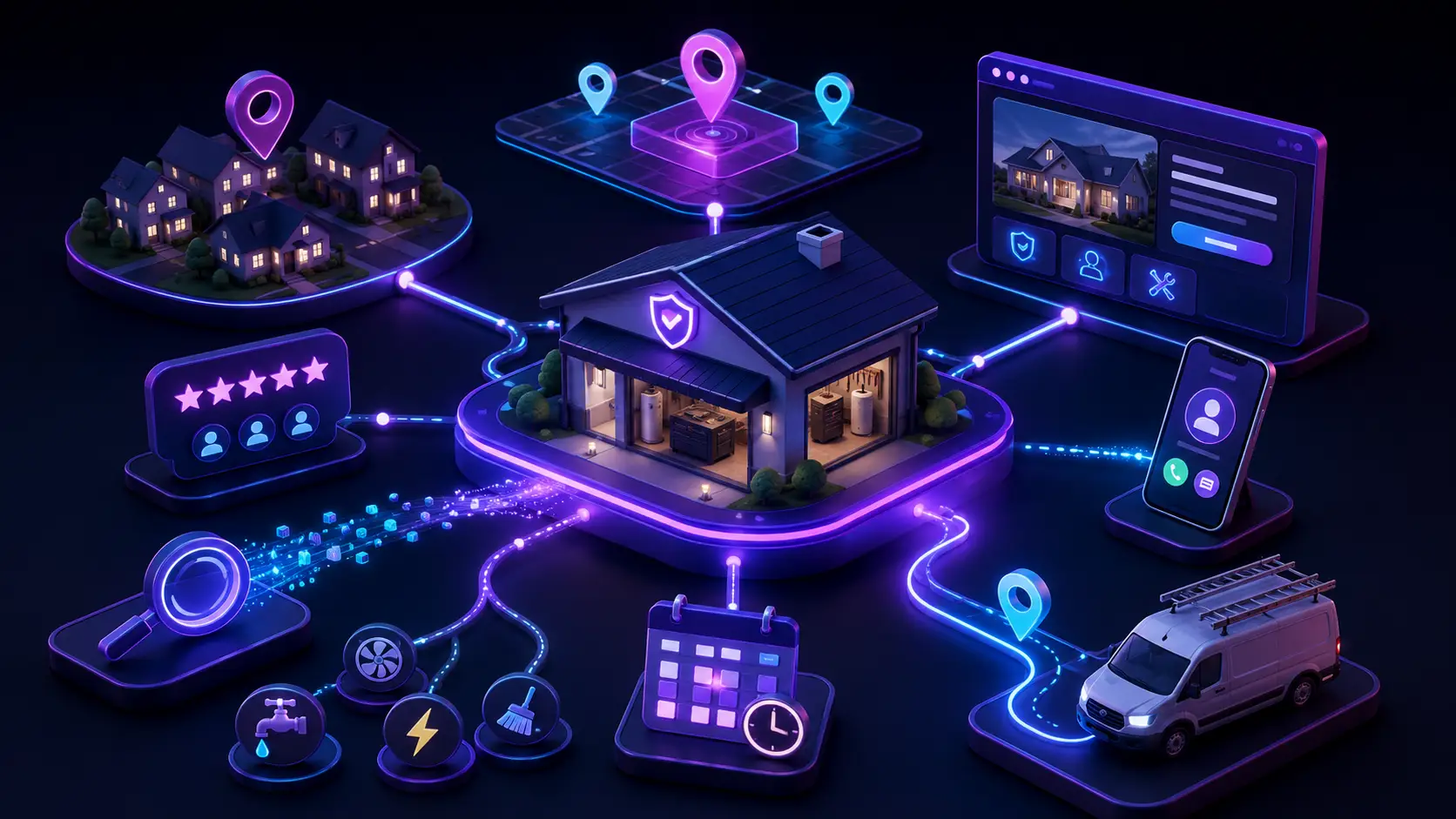
Homeowners Often Begin Evaluating the Business Before They Ever Call
A homeowner may discover a service provider through Google Maps, organic search, a referral, a review, social content, advertising, an AI-assisted answer, or a recommendation from someone they trust. Before making contact, they may want to understand what the business does, where it works, whether it appears dependable, what customers say about it, how quickly it may be able to respond, and what the next step looks like.
Digital trust is built from the consistency of many signals—not one review, one advertisement, or one search result.
KEY TRUST TOUCHPOINTS
- Accurate services and service areas
- Current hours and contact information
- Reviews and recent customer experience
- Clear website and service information
Urgent, Planned, and Recurring Service Needs Create Different Digital Presence Priorities
Urgent Service Need
- Easy-to-find phone number
- Accurate hours and availability
- Local proximity and service area
- Relevant service information
- Recent reviews
- Clear next step
Planned Project or Improvement
- Service and project information
- Reputation and customer experience
- Examples of completed work where relevant
- Estimate or consultation process
- Service-area clarity
- Time to compare providers
Recurring Maintenance
- Reliable contact information
- Scheduling and reminders
- Repeat-service communication
- Maintenance information
- Seasonal service needs
- Easy path back to the business
The home-services category provides context. The actual customer need determines which signals deserve the most attention.
Customers Need Consistent Information Wherever They Find the Business
Incorrect hours, outdated phone numbers, duplicate profiles, unclear service areas, incomplete services, and inconsistent business information can create friction before a homeowner ever reaches the website.
Home-service businesses should work toward consistent, useful information across the places where customers may encounter them. Depending on the business, important information may include service categories, service areas, hours, phone numbers, location details, appointment or estimate options, and other information customers need before making contact.
CRITICAL SERVICE INFORMATION
- Business name and phone
- Current business hours
- Accurate service categories
- Defined service areas
- Estimate or appointment options
CORE LOCAL DISCOVERY SIGNALS
- Website service-area information
- Google Business Profile accuracy
- Consistent directory listings
- Relevant local services
- Reviews and reputation
- Search intent alignment
Home-Service Discovery Is Often Closely Connected to Local Search
Many home-service searches have strong local intent because customers need a provider that actually serves their area. Local discovery can involve the relationship among the website, Google Business Profile, listings, service areas, reviews, relevant services, local information, and search intent.
The goal is not simply to “rank higher.” It is to help search systems and customers understand what the business does, where it works, and whether it may be relevant to the need.
Your Website Should Clearly Explain What You Do and Where You Work
The website is the environment where the home-service business has the greatest control over its own first-party information. Customers should be able to understand the services offered, areas served, how the business approaches the work, what to expect, how to make contact, and what the next step looks like.
Depending on the business, the website may also need to communicate project examples, FAQs, financing or payment information where appropriate, maintenance information, scheduling options, warranties or guarantees actually offered by the business, and other practical customer resources.
CRITICAL WEBSITE INFORMATION
- Clearly defined services
- Service-area information
- Calls, estimates, and scheduling paths
- Reviews or project proof where appropriate
- FAQs and customer expectations
- Helpful maintenance or service information
Clear Service and Project Information Can Be Part of the Trust Decision
Homeowners are often comparing more than company names. They may be trying to determine whether a provider offers the right service, works in their area, has experience with the type of problem or project, communicates clearly, and provides a reasonable next step. Clear service information helps customers determine whether the business may be relevant before they make contact.
Clear Service Information
Explain what the business actually provides, the types of problems or projects it handles, and any important boundaries customers should understand before requesting service.
Service-Area Clarity
Make it easier for customers to understand where the business operates instead of forcing them to guess whether their location is covered.
Proof of Experience
Where appropriate, reviews, project examples, photos, credentials supplied by the business, and practical experience can help customers evaluate trust and fit.
Reputation Can Influence Which Home-Service Business Gets the Call
Home-service customers often use reviews to understand how a business communicates, arrives, performs the work, handles problems, respects the property, and follows through. Reviews should be treated as one part of a larger trust system rather than the only factor influencing customer choice. TAF can help home-service businesses manage appropriate review-request, monitoring, and response workflows within the scope of the engagement.
ETHICAL REVIEW WORKFLOWS
- Review monitoring
- Appropriate response workflows
- Customer-experience feedback signals
LEAD & SERVICE CONNECTION PATHS
The best customer-engagement workflow is the one that matches how the business actually receives, routes, schedules, and follows up on service opportunities.
- Phone and contact pathways
- Quote or service-request forms
- Scheduling where supported
- Consent-based reminders and follow-up
The Next Step Should Be Fast, Clear, and Easy to Understand
Once a homeowner decides to contact a service provider, the Digital Presence should make the next step obvious. Depending on the business and systems in use, that may involve phone calls, estimate requests, scheduling, forms, messaging, reminders, lead routing, or follow-up communication. A digital form or automation is only useful when it connects cleanly with the people responsible for responding to the customer.
CUSTOMER DISCOVERY CONTINUES TO CHANGE
Search Systems Need Clear Information About the Business and Its Services
Search and AI-assisted discovery systems may encounter information about a home-service business across its website, listings, profiles, reviews, directories, content, and other available sources. Clear first-party information can help establish what the business does, where it works, what services it offers, and how customers can take the next step. That does not guarantee rankings, AI citations, recommendations, or visibility in any particular system.
DISCOVERY SOURCES
- First-party business website
- Google Business Profile and local listings
- Search results and local maps
- Reviews and service directories
- Service and location information
01. Explain Common Service Problems
Help customers understand common symptoms, service needs, maintenance issues, and situations where professional evaluation may be appropriate.
02. Set Clear Service Expectations
03. Demonstrate Practical Experience
Useful Content Can Help Homeowners Better Understand Services and Next Steps
Home-service businesses often answer many of the same questions repeatedly. Useful first-party content can help explain services, common problems, maintenance considerations, customer expectations, project preparation, frequently asked questions, and practical information.
The strongest content reflects actual business experience and useful subject-matter input rather than generic articles created simply to increase publishing volume.
Home-Service Advertising Works Best When the Campaign Matches the Service and Customer Path
Advertising may help create additional visibility for some home-service businesses, but the appropriate channel, audience, service, geographic coverage, landing destination, budget, tracking, and follow-up process depend on the campaign objective and business operations. Paid traffic still needs a clear customer path after the click.
GOOGLE ADS
Can help capture relevant search demand when customers are actively looking for a service. Campaign structure should reflect service areas, search intent, landing destinations, budget, and available conversion tracking.
SOCIAL MEDIA ADVERTISING
Can create paid audience reach around appropriate services, offers, seasonal needs, or awareness objectives where the platform and campaign strategy make sense.
Lead Routing, Scheduling, and Automation Should Fit How the Business Actually Operates
Implementation Factors
Useful implementation depends on how the business actually works:
- Who responds to new inquiries
- Service-area and scheduling rules
- Crew or technician availability
- Lead-routing responsibilities
- Existing CRM or operational systems
- Integration and customer communication requirements
Technology Should Support the Workflow—Not Create Another One
TAF can help evaluate whether forms, automation, scheduling, routing, messaging, CRM tools, and integrations actually support the business process. The best system is not necessarily the one with the most features.
THE CATEGORY IS BROAD
Home-Service Businesses Do Not All Have the Same Digital Presence Needs
HVAC, Plumbing & Electrical
- Strong local discovery
- Urgent and planned service needs
- Clear service areas
- Phone and scheduling pathways
- Reviews and reputation
- Seasonal service demand
Pest Control & Property Care
- Local service visibility
- Recurring customer relationships
- Service-area clarity
- Educational service information
- Reviews and customer confidence
- Scheduling and follow-up
Cleaning & Maintenance
- Clear service packages
- Local trust and reputation
- Quote or booking pathways
- Recurring service communication
- Service-area information
- Customer-experience signals
Handyman & Specialty Home Services
- Broad service clarity
- Project and capability examples
- Local reputation
- Estimate pathways
- Service-area communication
- Clear customer expectations
- Service and pricing clarity where appropriate
Multi-Crew or Multi-Location Operators
- Consistent business information
- Multiple service areas or locations
- Lead-routing coordination
- Review and reputation consistency
- Location or service-area pages
- Operational communication at scale
These are common considerations, not predetermined packages. The actual business and customer journey determine the strategy.
How Digital Presence Fits Together for Home Services
Business Information & Listings
Help customers find accurate hours, phone numbers, service categories, locations, and service-area information.
Reviews & Reputation
Add independent customer-experience and trust signals that can help homeowners evaluate the business.
Website & First-Party Authority
Give the business a controlled source for services, service areas, project information, customer resources, and clear next steps.
Content & Social Presence
Search & AI Visibility
Help search and AI-assisted systems find, interpret, and corroborate information about the business and the services it provides.
Customer Engagement
Help people move from discovery toward the appropriate call, quote request, appointment, scheduling, or follow-up path.
Strong home-service Digital Presence is not one tactic. It is the relationship among accurate information, local discovery, first-party authority, independent trust signals, useful communication, and the customer experience.
TAF Can Help Strengthen the Areas That Matter Most to the Business
Not every home-service business needs every capability. Scope should reflect the services offered, customer journey, service areas, current Digital Presence, operational process, available resources, and business priorities.
Home-Service Digital Presence Benefits From Understanding How Customers Choose and Contact Providers
TAF Solutions has worked with local service businesses across different customer journeys, service areas, and Digital Presence needs. That experience helps us recognize common challenges while still evaluating each business based on its actual website, reputation, search visibility, customer communication, operations, technology, and priorities.
Customer Journey Mapping
Understanding how urgent, planned, and recurring service needs move from discovery toward calls, quotes, scheduling, and completed work.
Trust Signals & Conversion UX
Creating clear interfaces that help customers evaluate services, reputation, service areas, proof of experience, and the next step.
Website & Discovery Foundations
Structuring first-party information to support local discovery, customer education, trust, and clear contact pathways.
Choose the Level of Digital Presence Support That Fits the Business
Tools + Guidance
For businesses that want supported Digital Presence tools, education, and guidance while remaining involved in execution.
Managed Digital Presence
For businesses that want TAF to actively manage agreed-upon parts of their Digital Presence.
Digital Presence Consulting
For businesses that need strategy, evaluation, planning, troubleshooting, prioritization, platform guidance, or a second opinion.
Home-Service Industry Context Helps Identify Priorities—but It Does Not Replace an Assessment
Why Generic Industry Benchmarks Fall Short
- Local competitive conditions
- Your actual customer journey
- Technical and information gaps specific to your setup
Home Services Digital Presence Questions
How important is Local SEO for a home-service business?
Do reviews matter for home-service companies?
Should every service have its own website page?
Can TAF help clarify our service areas online?
Should a home-service business use Google Ads or Social Media Advertising?
Can content help our home-service business appear in AI-assisted search?
Is this only for large home-service companies?
BUILD TRUST BEFORE THE SERVICE CALL