LEAD FUNNELS & MARKETING AUTOMATION
Turn Interest Into Clear, Trackable Next Steps
TAF helps businesses build structured conversion paths that capture inquiries, organize useful lead information, route people toward appropriate next steps, and support timely follow-up through connected forms, landing pages, workflows, and automation.
FROM DISCOVERY TO ACTION
Getting Attention Is Only the Beginning
The goal is not to automate every interaction. It is to make the path from interest to action clearer and easier to manage.
Someone finding your business online does not automatically create a useful lead.
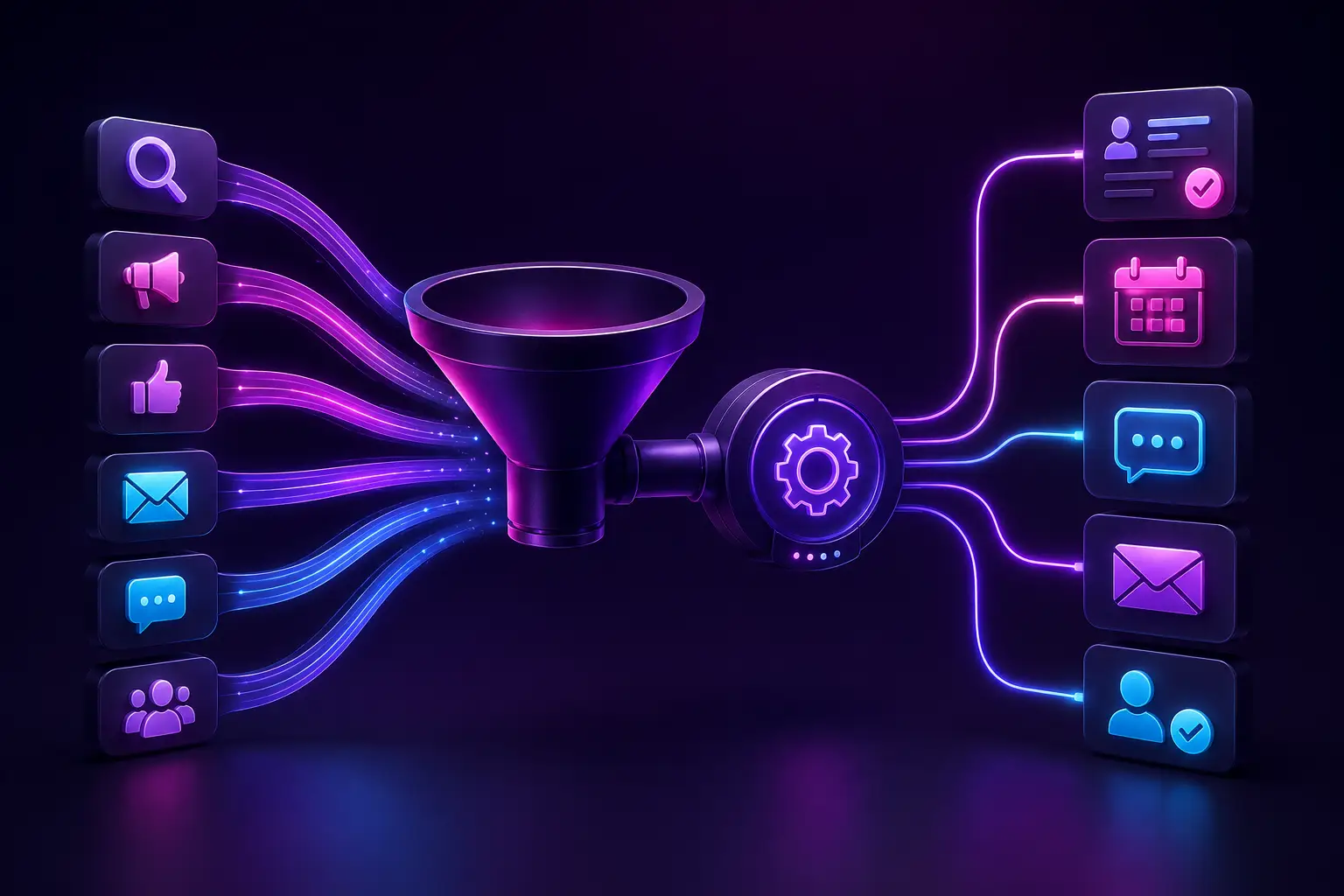
A potential customer may visit your website, click an advertisement, read a social post, open an email, or discover your business through search. What matters next is whether that person has a clear way to take action—and whether your business has a practical process for handling what happens afterward.
Lead funnels and marketing automation help connect those moments by creating structured pathways for inquiries, appointments, requests, downloads, consultations, and other appropriate next steps.
THE CONVERSION SYSTEM
What Lead Funnels & Marketing Automation Actually Mean
Lead Funnels
A lead funnel is a structured path designed to help someone move from interest toward an appropriate next step.
Depending on the business, that path may include a focused landing page, form, scheduling option, confirmation page, downloadable resource, consultation request, or another useful action.
Lead funnels help organize the customer journey.
Marketing Automation
Marketing automation uses defined rules, triggers, and connected systems to support what happens before, during, or after someone takes an action.
That may include notifications, confirmations, lead routing, reminders, follow-up communication, segmentation, or other supported workflow steps.
Automation helps organize the business response.
Funnels create the path. Automation helps manage what happens along the way.
Capture → Qualify → Route → Follow Up → Learn
Capture
Give interested people a clear way to take the next step and provide the information needed to continue the process.
Qualify
Use appropriate questions, selections, or actions to better understand what the person is looking for.
Route
Direct inquiries, information, and tasks toward the appropriate person, calendar, pipeline, system, or next step.
Follow Up
Use appropriate communication and automation to acknowledge requests, support timely responses, and continue the process when useful.
Learn
Review available performance and workflow information to identify friction, gaps, and opportunities to improve the path.
A good conversion system should make things clearer for both the customer and the business.
Build Clear Conversion Paths
- Focused landing pages and forms
- Scheduling and consultation pathways
- Downloads, confirmations, and next steps
Customers should not have to guess what to do after they become interested in your business.
Depending on the goal, TAF can help create focused landing pages, forms, calls to action, scheduling pathways, consultation requests, confirmation experiences, downloadable resources, and other appropriate next steps.
The objective is not to force every visitor through the same funnel. It is to create a path that makes sense for the action you are asking them to take.
Capture the Information You Actually Need
A form should collect enough information to support the next step without creating unnecessary friction.
The right questions depend on the business, the offer, and what needs to happen after the inquiry.
TAF helps structure lead capture around useful information rather than simply collecting as many fields as possible. Appropriate information can help the business understand the request, prepare for a conversation, route an inquiry, or determine the most useful next step.
- Ask only what supports the next step
- Collect useful context for the inquiry
- Structure information for appropriate routing
Route Inquiries Appropriately
Not every inquiry needs the same destination.
Depending on the workflow, information may need to reach a specific person, team, calendar, pipeline, notification system, or another supported business tool.
TAF helps design routing logic around the way the business actually operates so captured information can move toward an appropriate next step. Automation can support that movement, but the underlying rules and business decisions still need to be clearly defined.
Forms, requests, bookings, or other triggers
Business logic based on the inquiry and desired next step
Person, calendar, pipeline, notification, or supported system
Follow Up Without Making Everything Manual
Some parts of follow-up are repetitive and predictable. Others require human judgment.
Appropriate automation can support acknowledgements, confirmations, reminders, internal notifications, nurture communication, task creation, and other defined workflow steps.
The purpose is not to remove people from customer relationships. It is to reduce unnecessary manual work while helping important actions happen more consistently.
Use automation where it improves execution. Keep people involved where judgment and relationships matter.
Funnels Are More Than Landing Pages
A landing page may be where a conversion path begins, but the page itself is only one part of the system. A useful funnel may include the page, call to action, form, captured information, confirmation, scheduling option, routing logic, communication, tracking, and the next action expected from either the business or the customer. Building these pieces together creates a more complete conversion system than simply publishing another page.
01. ATTRACT & ACT
Focused pages, calls to action, and appropriate entry points.
02. CAPTURE
Forms, scheduling, requests, and useful information collection.
03. ROUTE
Defined rules that move information toward an appropriate next step.
04. FOLLOW UP
Confirmations, communication, tasks, and supported workflow actions.
How Funnels & Automation Fit Within Digital Presence
Website
Provides the first-party source of truth and often hosts important conversion pathways.
Social & Content
Creates ongoing public communication and can generate interest.
Email & SMS
Provides planned, business-initiated communication with appropriate audiences.
Customer Engagement
Supports direct conversations, questions, requests, and customer interactions.
Lead Funnels & Automation
Organizes conversion paths, captured information, routing, and workflow logic.
Advertising
Can introduce additional targeted traffic into appropriate conversion pathways.
Agentic AI
Can support or execute approved actions within appropriate workflows when the capability is supported, permitted, and properly governed.
These capabilities can work together, but they do not all perform the same job.
RELATED, BUT DIFFERENT
Communication Delivers the Message. Automation Supports What Happens Next.
Marketing Communication
Email, SMS, social content, advertising, and other communication help deliver information to an audience.
The message, audience, timing, and purpose remain central to the communication strategy.
Marketing Automation
Automation can respond to defined actions or conditions by supporting appropriate workflow steps such as routing, notifications, segmentation, reminders, or follow-up.
Use AI to Support the Workflow—Not Replace the Strategy
AI can support parts of a conversion workflow when the tools, information, permissions, and use case make sense.
Depending on the supported environment, AI may assist with analyzing information, summarizing inquiries, drafting communication, identifying patterns, classifying information, supporting routing decisions, or performing approved workflow actions.
AI does not eliminate the need for clear business rules, accurate information, appropriate permissions, human oversight, or a defined customer experience.
FROM STRATEGY TO EXECUTION
Plan → Build → Launch
Plan
Define the objective, audience, conversion path, information requirements, business process, and desired next step before building the system.
Build
Create and connect the appropriate pages, forms, calls to action, routing, communication, workflow logic, tracking, and supported integrations.
Launch
Test the pathway, activate the appropriate components, review available performance information, and refine the system where appropriate.
“Launch begins the measurement and refinement process—it does not replace ongoing management or oversight.”
What TAF Actively Manages
The exact system depends on the business, the customer journey, the tools being used, and the scope of the TAF engagement.
Conversion-path planning
Landing pages
Forms and lead capture
Calls to action
Scheduling pathways
Lead-routing workflows
Notifications & follow-up
Supported integrations
Tracking configuration
Workflow testing
Ongoing review & refinement
System Design
Structured around the business process, customer journey, tools, and scope of the engagement.
LEARN FROM THE PATH
Use Performance Data to Improve What Happens Next
When appropriate tracking is available, conversion systems can provide useful information about how people interact with the path.
Depending on the tools and workflow, that may include form activity, tracked actions, booking activity, traffic sources, workflow activity, communication interactions, and points where people stop progressing.
These signals can help identify friction and inform future improvements.
Performance information helps inform better decisions. It does not guarantee business outcomes.
Common Performance Signals Reviewed
- Form activity and workflow drop-off
- Communication interactions and bookings
- Traffic sources and tracked conversion paths
Is Lead Funnels & Marketing Automation Right for Your Business?
Funnels and automation are most useful when there is a clear customer action or business process worth organizing.
TAF can help determine where added structure or automation creates practical value—and where a simpler approach may be better.
This may be a good fit if your business:
- Regularly receives inquiries or leads online
- Needs clearer conversion paths
- Uses forms, scheduling, or consultation requests
- Has repetitive follow-up or routing tasks
- Wants better organization around lead information
- Is running or planning advertising campaigns
- Needs several systems or communication steps to work together
When it may not make sense: Automating an unclear process often adds complexity rather than solving it. In those cases, defining the manual process first may be the better starting point.
Ready to Build a Clearer Path From Interest to Action?
See how your current website, communication, customer engagement, and conversion pathways work together—and where clearer structure could strengthen your Digital Presence.